
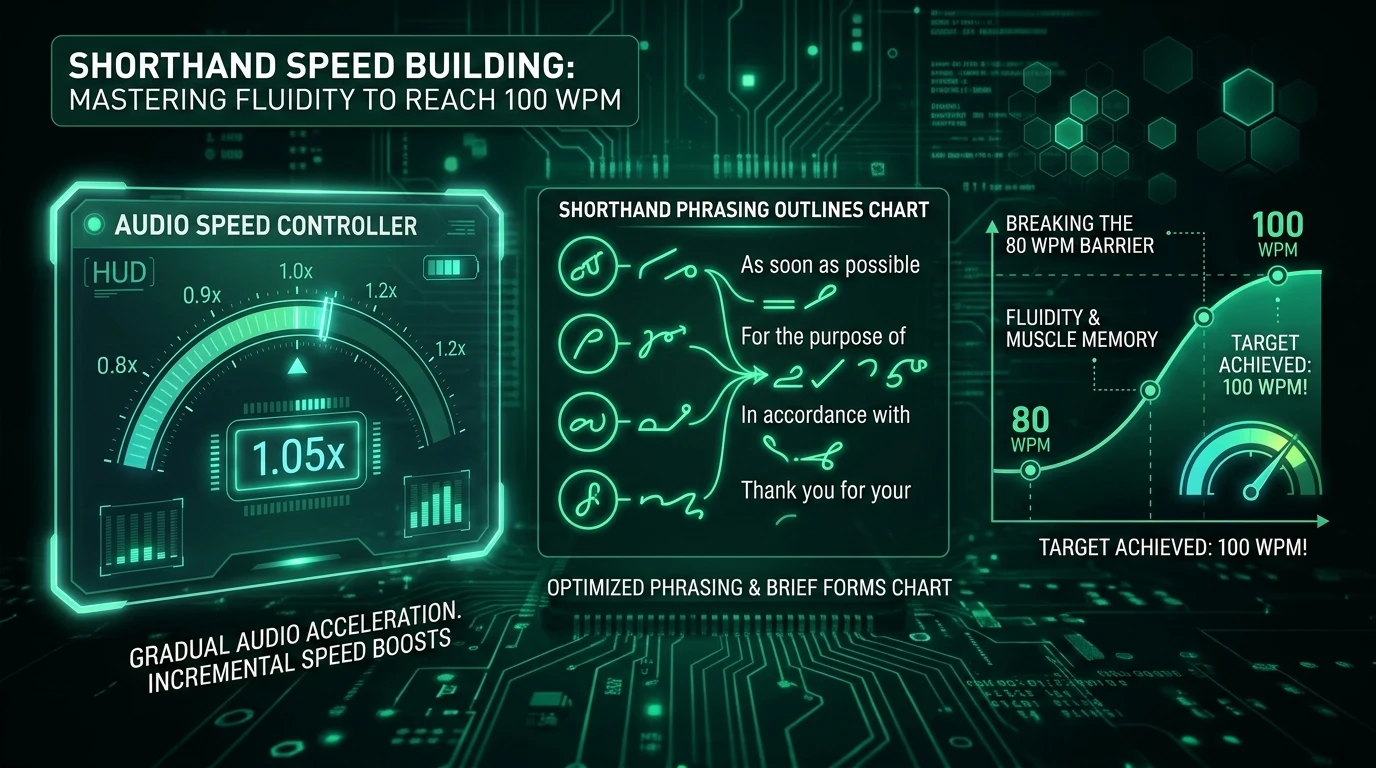
Introduction: The Universal "80 WPM Wall" Every Steno Aspirant Hits
In shorthand coaching institutes across India, a familiar pattern repeats itself: a dedicated student moves from 0 to 60 WPM in 4 months, reaches 80 WPM by month 6, and then completely freezes. For the next 8 months, their speed refuses to budge past 80 words per minute.
The moment an audio test accelerates to 100 WPM (the mandatory qualifying benchmark for SSC Stenographer Grade C, Parliamentary reporting, and High Court exams), their outlines degenerate into messy scribbles, they miss 30 words in a row, and hand fatigue forces them to quit.
Here is the scientific reality: 80 WPM is an acoustic listening limit, whereas 100 WPM is a neuromuscular reflex challenge. To cross 100 WPM, you cannot simply practice more of the same—you must fundamentally rewire your stroke execution mechanics.
The 5 Neurological Reflex Drills to Break Through 100 WPM
1. The "Over-Speed Overload (+15 WPM)" Protocol
Your auditory cortex adapts to the pace you routinely feed it. If you only practice at 100 WPM, test-day stress will drag your functional capacity down to 90 WPM.
Follow the daily Tri-Speed Escalation Method on the exact same 400-word passage:
- Run 1 (Baseline - 90 WPM): Focus on textbook geometric precision and flawless line positioning.
- Run 2 (Overload - 115 WPM): Deliberately push past your comfort zone. Do NOT worry if outlines wobble—force your hand to keep pace and never lift the pencil.
- Run 3 (Target - 100 WPM): Replay the dictation at 100 WPM. Because your brain just experienced 115 WPM, 100 WPM will feel slow, relaxed, and effortlessly readable!
2. The "4.5 Millimeter Stroke Compression" Rule
Take a transparent ruler and measure your straight downstrokes (like 'T', 'D', 'P', 'B'). If your strokes are 6mm or 7mm long, your pencil tip is traveling 40% more physical distance across the page than a professional reporter's pencil.
Train your hand to keep all straight consonants under 4.0 to 4.5 millimeters. Compact outlines mean less wrist travel and automatic +15 WPM speed gains.
3. Grammatical Phrase Anchoring (Never Write Single Words)
At 80 WPM, you write: "It" (lift) "has" (lift) "been" (lift) "stated". At 100 WPM, those 4 pencil lifts waste 1.2 precious seconds. Train your hand to join high-frequency clauses into single fluid ligatures without leaving the paper.
4. Total Elimination of Medial Vowels
At 100 WPM, inserting vowel dots after consonants is suicide. Vowels must be communicated 100% through Line Placement (स्थान नियम):
- Above the line = 'A' / 'Aw' vowel sound
- On the line = 'E' / 'O' vowel sound
- Through the line = 'Ee' / 'Oo' vowel sound
Frequently Asked Questions
Shorthand me 80 se 100 WPM aane me kitna time lagta hai?
Tri-speed escalation drills (+15 WPM overload) aur compact outline rules ke sath ek average student 6 se 8 hafte me 80 WPM ka plateau break karke 100 WPM cross kar leta hai.
100 WPM par hand pain aur forearm fatigue se kaise bachein?
Pencil ko zordar dabakar na pakdein. Haldi aur lightweight grip rakhein, aur steno notepad ko desk par 30 degree tilt karke likhein taaki wrist friction kam ho.
Kya SSC Grade C ke liye 100 WPM se zyada practice karni chahiye?
Haan, exam hall me nervous tension se 5-10 WPM speed drop hoti hai, isliye ghar par hamesha 110 WPM clear karke jana chahiye taaki 100 WPM easy lage.
Test Your Shorthand at 100 WPM Online
Practice Kailash Chandra and Ramdhari Gupta passages with our variable speed audio player (80, 90, 100, 110, 120 WPM) and check your transcription mistakes instantly on StenoTypingTest.